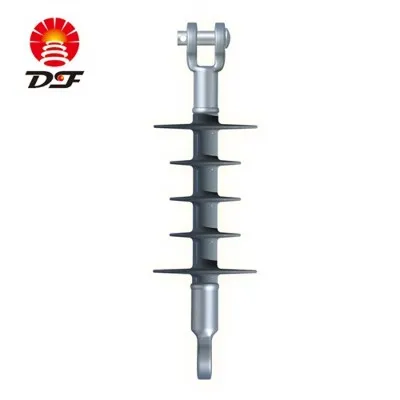
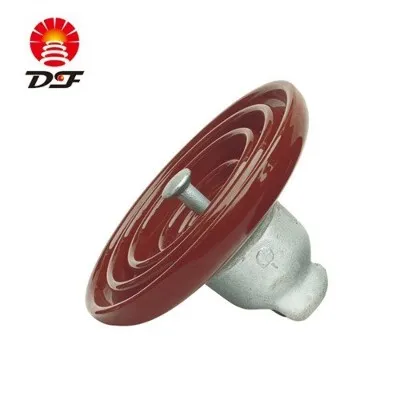
Toughened glass insulator has better mechanical and electrical properties. Its tensile strength, electrical breakdown resistance, vibration fatigue resistance, arc burn resistance and cold and hot shock resistance are better than porcelain insulator. Ceramic insulator has the advantages of good insulation performance, climate change resistance, heat resistance and flexible assembly. It is widely used in lines of various voltage levels. Disc porcelain insulators are of the breakdown type
Service life of insulator glass insulator has the characteristics of zero value self explosion. The first reason for self explosion is the impurities and nodules in the glass during the manufacturing process. If the impurities and nodules are distributed in the inner tension layer, some of them will self explode within a period of time after the product is made. Therefore, the manufacturing unit shall store the products for a period of time after manufacturing, so as to find the potential quality hazards in manufacturing. If impurities or nodules are distributed in the outer compression layer, after running on the transmission line for a period of time, under the action of strong cold and hot temperature difference and electromechanical load, it may cause self explosion of glass insulation. In addition, partial discharge will occur under the action of power frequency voltage after the dirt layer on the surface of glass insulator is damped during operation. The long-term heating caused by partial discharge will lead to the decline of glass insulation and zero value self explosion. Therefore, the self explosion rate of glass insulators operating in seriously polluted areas will increase. However, the self explosion rate of glass insulator is different from the deterioration rate of porcelain insulator and the aging rate of organic composite insulator. The self explosion rate of glass insulator belongs to early exposure. With the extension of operation time, the self explosion rate shows a downward trend year by year, while the deterioration rate of porcelain insulator belongs to late exposure. With the extension of time, the deterioration rate will gradually increase under the combined mechanical and electrical load. Due to the aging characteristics of organic materials, the aging rate and deterioration rate of composite insulators will increase with time. In foreign countries, it is generally considered that the aging life of glass insulators and porcelain insulators is about 50 years, while the aging life of composite insulators is no more than 25 years