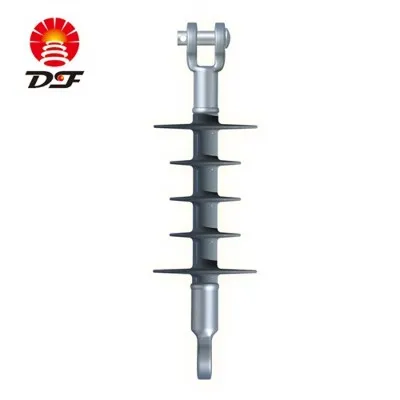
Usually, the wet lightning voltage of an X-4.5 type suspension insulator is 45Kv(the anti-fouling type is higher), 3 to 4 pieces are used on the contact network, the wet lightning voltage of the rod insulator is 100kV~170kV, and the highest working voltage of the catenary is about 30kV, so under normal circumstances, rain will not affect the normal power supply, unless the insulator is dirty. Resulting in reduced electrical performance, it may cause flashover on the insulator surface, and even cause breakdown.
The main defects of pillar porcelain insulator probe high voltage porcelain bottle are cracks, inclusions, pores and so on. These defects reduce its mechanical and dielectric strength. The longitudinal cracks and transverse cracks in high pressure porcelain bottles are detected by ultrasonic wave and the porosity can be determined by sound velocity. The detection frequency is generally 2 to 5 MHZ. When detecting unprocessed porcelain by water immersion method, 0.5~2 MHZ can be used. In addition to the general probe, there are special probes for detecting high-pressure porcelain bottles, namely, flat probes for transmitting longitudinal waves and S-shaped probes for transmitting transverse waves. The two probes have narrow contact surfaces and can be placed between two porcelain plates close to the insulator for detection. The contact surface of the S-shaped probe has an arc, which is in good agreement with the surface of the high-pressure porcelain bottle.
First, longitudinal crack detection
The longitudinal cracks of the porcelain core of the solid insulator can be detected on the ceramic cylinder between the metal cover and the porcelain plate or between two porcelain plates with a flat probe of 4 MHZ (longitudinal wave). When the porcelain core is without defects, there will be a very clear bottom wave at the fixed position of the fluorescent screen. When there is a defect, the defect wave occurs before the bottom wave.
Second, transverse crack detection
The solid insulator is close to the end surface of the porcelain cylinder in the metal cover, which is easy to produce transverse cracks. The S-shaped probe (shear wave) can be used to detect the surface of the porcelain cylinder between the metal cover and the first porcelain plate (or the first and the second), as shown in Figure 1. The Angle of the probe should be selected so that the beam may be emitted to the end face of the porcelain cylinder with the metal cover, and the probe with the diffusion Angle should be selected for this purpose. When detecting, the probe moves in a circular motion while moving back and forth between the porcelain plates as much as possible. When there is no defect, the reflection wave of the ceramic cylinder inside the metal cap appears at a certain yl on the fluorescent screen. When there is a crack, the defect wave appears in the front of the reflection wave. Transverse cracks of solid insulators can also be detected on the end face of the insulator by longitudinal waves. When detecting insulators of different lengths by longitudinal waves, the directivity of the sound beam should be taken into account, which is mainly determined by the frequency. For example, when the insulator length is more than 1000 mm, 1 MHZ is used; When the length is 450~700 mm, use 2.5 MHZ, and when the length is less than 450 mm, use 5 MHZ.