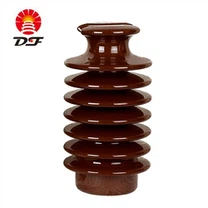
1. What is an insulator?
A device that is mounted between a conductor of varying potential or between a conductor and a grounded member and that can withstand voltage and mechanical stress. Insulators come in many varieties and shapes. Although the structure and shape of different types of insulators are quite different, they are composed of two parts: insulation parts and connecting tools. Insulator is a kind of special insulation control, which can play an important role in overhead transmission lines. In the early years, insulators were mostly used in telephone poles, and gradually developed into a high voltage wire connecting tower with a lot of disk-like insulators, which are hung at one end to increase the creepage distance. They are usually made of glass or ceramic, so they are called insulators. Insulators should not fail due to various mechanical and electrical stresses caused by changes in environmental and electrical load conditions. Otherwise, insulators will not play a significant role, which will damage the service and operating life of the whole line.
2. What is the principle?
The main function of insulators is to achieve electrical insulation and mechanical fixation, for which there are various requirements for electrical and mechanical properties. If under the specified operating voltage, lightning overvoltage and internal overvoltage, no breakdown or flashover along the surface occurs; In the specified long-term and short-term mechanical load, no damage and damage; After long-term operation under specified mechanical and electrical loads and various environmental conditions, there is no obvious deterioration; A fixture of an insulator that does not produce obvious corona discharge at operating voltage so as not to interfere with radio or television reception. Because insulator is a large number of devices, the connection of the metal also requires interchangeability. In addition, the technical standards of insulators also require various tests of electrical, mechanical, physical and environmental conditions to test their performance and quality according to the different types and conditions of use.
3. Classification.
According to different installation methods, insulators can be divided into suspension insulators and pillar insulators; According to the different insulation materials used, can be divided into porcelain insulator, glass insulator and composite insulator (also known as synthetic insulator); According to the use of different voltage levels, can be divided into low voltage insulator and high voltage insulator; According to the different environmental conditions of use, derived the pollution resistance insulator used in dirty areas; According to the different types of voltage used, derived DC insulator; There are a variety of special purpose insulators, such as cross arm insulation, semiconductor glaze insulators and power distribution tension insulators, bobbin insulators and wiring insulators. In addition, according to the different breakdown possibilities of insulating parts, they can be divided into type A (non-breakable type insulator) and type B (breakable type insulator).
Liling Dongfang Electroceramic Co., Ltd
+86-15974274832
 Language
- English
- 简体中文
- Español
- Việt Nam
- ไทย
- русский
- عربي
- Italiano
- Português
- Français
- Deutsch
- Indonesia
- 日本語
- 한국어
- Türkçe
- Čeština
- Eesti
- Gaeilgenah Éireann
- Bai Miaowen
- íslenska
- Cymraeg
- Български
- اردو
- Polski
- hrvatski
- українська
- bosanski
- فارسی
- Lietuvių
- Latviešu
- עברית
- România limbi
- Ελληνικά
- dansk
- magyar
- Norsk
- suomi
- Nederlands
- Svenska
- slovenčina
- slovenščina
- हिंदी
- Melayu
- Malti
- Kreyòl Ayisyen
- Català
- বাংলা
- Srbija jezik (latinica)
- O'zbek