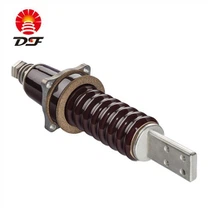
Insulator: A device used to withstand potential differences in electrical equipment or conductive electrical insulation and mechanical fixation.
Insulator body: the middle part of an insulator from which the umbrella extends.
Core (of an insulator) : The central insulating part of an insulator that provides mechanical properties. Note: The cover and umbrella are not part of the core body.
Glaze: A glassy surface layer on the insulating parts of a porcelain insulator.
Mechanical failure load: the maximum load reached by an insulator during testing under specified test conditions.
When you see an insulator, you immediately think of the composition of an insulator: an insulator (commonly known as a porcelain bottle) is composed of a porcelain part and a gold part, and the middle part is glued with cement adhesive. The porcelain part is to ensure that the insulator has good electrical insulation strength, and the gold tools are used to fix the insulator.
2. The role of insulators has two aspects: one is to firmly support and fix the current-carrying conductor, and the other is to form good insulation between the current-carrying conductor and the ground.
Mechanical and dimensional characteristics of insulators:
-- Mechanical or mechanical failure load: kN;
-- Maximum nominal diameter of insulation parts :D;
-- nominal structure height :P;
-- Minimum nominal creepage distance: unit mm;
-- Standard connection tag.
3. Insulators have two functions: one is to firmly support and fix the current-carrying conductor, and the other is to form good insulation between the current-carrying conductor and the ground, which is both fixed and insulated. Fixed: One end is fixed to a tower or support object and the other end is fixed to a conductor. Insulation: both conductive and tower ground insulation. The insulation of insulators mainly depends on the insulating medium, insulating medium: porcelain, glass, composite materials and so on.
Umbrella (of an insulator) : The protruding insulating part of the body of an insulator used to increase the creepage distance.
Creepage distance: The shortest distance or sum of the shortest distances along the surface between conducting parts to which the insulator normally applies operating voltage. Note 1: Surfaces of cement or other non-insulating adhesive materials cannot be included in the creepage distance. 2: If a high resistance layer is applied on the insulating part of an insulator, the insulating part shall be regarded as an effective insulating surface, and its surface distance shall be included in the creepage distance.
This is why our insulators are designed in the shape of this umbrella, in order to increase the creepage distance. While increasing the creepage distance, we cannot reduce the mechanical strength, so sometimes we need to use many pieces.
It is mentioned here that, because our insulators mainly work in outdoor environment, affected by weather and air pollution, pollutants or dust will accumulate on the surface of insulators, reducing the insulation degree of insulators. Therefore, we should take into account different voltage levels, different environments, different levels of pollution, and different types of selection before the early design.
Specific creepage distance of insulator: total creepage distance of insulator L divided by the product of test voltage and square root of 3; It is usually expressed in mm/kV.
Uniform creepage distance: The ratio of creepage distance of an insulator to the effective value of the highest operating voltage at both ends of an insulator. Generally, the unit is mm/kV.
In transmission line design, insulator selection is one of the main basis.
Flashover (insulator's) : A penetrating discharge outside and along the surface of an insulator that causes an electrical connection between parts that would normally be subjected to operating voltage. For example, in foggy days, under the influence of humid air, the corona effect produced by the insulator surface.
Breakdown (insulator's) : A destructive discharge through an insulator to fix an insulating material, permanently losing its insulation strength. Breakdown is also a kind of conductive field. The insulation degree of the insulator cannot withstand the voltage transmitted by the erected conductor, leading to the discharge of high voltage to low voltage, resulting in the breakdown of the insulator.
2, insulator use
1, tensile force: mainly bear the tension generated by the wire, the broken wire is fixed on the tower. Generally used for high pressure tension tower, high pressure linear tower, medium and low pressure tension, terminal rod, Angle rod.
2, supporting effect: the main bearing wire pressure, transverse wind load, etc. Fix the unbroken wire to the tower. Generally used for low - and medium-voltage resistant linear tower, small Angle rod, lead, etc.