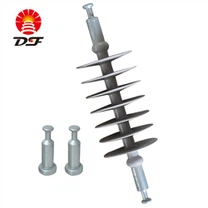
The composite post insulator is composed of a mandrel, an umbrella skirt sheath and a connecting fixture. The core rod is made of fiberglass steel, which is used to provide the mechanical properties of the insulator. The sheath is connected to the surface of the core rod through the adhesive, which plays the role of protecting the core rod. The connecting fixture is located at both ends of the composite pillar insulator, which plays the role of connecting the composite pillar insulator with the pole and tower hardware.
The end connection mode of composite post insulator can be divided into wedge type and crimping type. Wedge type can be divided into outer wedge type and inner wedge type.
The production technology of insulator umbrella skirt and mandrel can be divided into extruded umbrella and integral injection. The extruded umbrella is to glue the umbrella skirt to the mandrel, so there are two interfaces: mandrel - sheath and sheathing - umbrella cover. The umbrella skirt and mandrel sheath are formed in one body in the integral injection type, and only the mandrel - sheath interface is available.
The failure of composite post insulator includes flashover, mechanical strength decline, mandrel breakdown, brittle break, mandrel crisp rot, external damage, etc. Among them, the external force damage is related to the external environment control, and the others mainly depend on the insulator's own state, which is closely related to aging.
At present, the composite pillar insulator mainly adopts the crimping type connection structure, and the composite pillar insulator of this structure almost no longer produces the event of breaking the string of the insulator due to the decrease of mechanical properties. In the case of acid-resistant mandrel, the composite post insulator almost no longer produces brittle breakage.
Therefore, at present, the failure of composite pillar insulators related to aging mainly includes mandrel breakdown and brittle fracture. Since decreased hydrophobicity may also cause discharge and damage to the mandrel, decreased hydrophobicity is also considered to be a form of failure associated with aging.