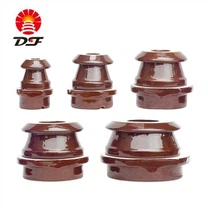
What kind of insulators are used for overhead lines? Advantages and disadvantages of using porcelain crossarm for overhead line:
At present, the high and low voltage lines in many countries use porcelain cross arm, which is also widely used in our country. On 6-10 kV lines, conical porcelain crossarms are generally used.
Porcelain cross arm has the following advantages:
(1) The insulation level and lightning resistance level are high, the natural cleaning effect is good, the accident rate is low, and the use in dirty areas is more reliable than the pin insulator.
(2) Because the porcelain cross arm is relatively light, easy to clean, easy to construction, maintenance and live work.
(3) Because the porcelain cross arm can automatically deflect a certain Angle, in case the wire is broken, it can relax the wire by itself to prevent the expansion of the accident. The main disadvantage of porcelain crossarm is that its mechanical strength is lower than that of iron crossarm, and it is easy to be damaged or broken during construction and transportation. Therefore, it is used more in less populated places. If its strength is increased, or its material is further improved, the porcelain crossarm will be further popularized and applied.
Convex and concave ripples on the surface of high voltage insulators can cause the following effects:
(1) The arc climbing length is extended, and the arc climbing distance of the arc is increased within the same effective height, and each ripple can play a role in blocking the arc and improve the sliding lightning voltage of the insulator.
(2) In heavy rain days, the sewage washed down by heavy rain can not flow directly from the upper part of the insulator to the lower part to form a water column and cause a grounding short circuit, and the ripples on the insulator play a role in blocking the water flow.
(3) When dirt falls on the insulator, it is not evenly distributed in the convex and concave parts of the insulator, so the pressure strength of the insulator is ensured to a certain extent.
The insulator on the terminal pole of the overhead line has a higher probability of damage. The insulator on the terminal pole is located at the end of the line. When the lightning wave attacks, it will reflect on the terminal pole. In severe cases, the voltage of the terminal pole is twice that of the lightning voltage.