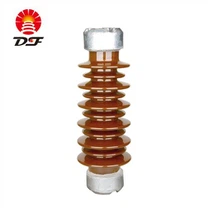
The broken string forms of composite post insulators can be divided into three categories: external tearing, brittle fracture and decay. Among them, there are few cases of external force tearing, and brittle fracture and decay are the main types of broken strings. The causes of external tearing are usually extreme winds, severe ice freezing, ice jumping, etc. In these cases, composite post insulators are forced out of design, resulting in broken strings.
In general, the mechanical strength control part is usually the ball head and neck, that is, when only the stress is applied, the first break is usually the ball head. However, when subjected to a combination of torsional, tensile or compressive stresses, the joint position of the composite post insulator and the mandrel is weak, so the break position is usually located at the joint and the mandrel joint. The mandrel is made of high strength glass fiber. Under the combined action of torsional stress and tensile stress, the core rod fracture is often uneven, some fibers are broom-like, the fracture has no carbonization traces, brittle fracture is the early stage of composite post insulator used for string breaking. The fracture process is accompanied by stress corrosion process. The breaking position can be located inside the fitting, near the joint between the fitting and the mandrel. The obvious feature of brittle fracture is that the fracture is mostly flat and smooth, and the cross section is perpendicular to the axis of the mandrel.
Brittle fracture is usually accompanied by stress corrosion process. The insulator withstands the tension of the wire. When the spindle enters the acidic liquid for some reason, the acidic liquid will corrode the spindle. The acid-resistant mandrel used in early composite post insulators was pulled. Under the combined action of corrosion, the mandrel gradually cracks, and the crack gradually expands until the remaining mandrel cannot withstand the tension and fracture.